The neon bustle of Tokyo is thrilling, but to experience Japan's true tranquility, you must leave the city. Welcome to the world of "onsen," where steam rises and silence envelops everything.
However, for many inbound travelers, onsen are as appealing as they are confusing. They raise many questions: "Do I have to be naked?" "Am I allowed in if I have tattoos?" "How do I get there?"
Rest assured. This article is your ultimate guide. We are here to help you step confidently into Japan's most sacred relaxation experience.
From the fundamentals of etiquette and solutions for the tattoo issue, to a thorough guide on the "Top 5 Onsen Areas" easily accessible from Tokyo—this guide covers it all. Read this, and you will be an onsen master.
Chapter 1: The First-Timer's Onsen Toolkit: Turning Anxiety into Confidence
Unlike Western pools, onsen are not places for swimming or socializing. They are quiet places for "soaking" and relaxing the mind and body. Understanding this cultural purpose is the first step.
Section 1.1: A Complete Guide to Onsen's "Implicit Rules"
- Entrance and Changing Room
- Baths are strictly separated by gender. Check the "noren" (curtain) at the entrance. Typically, blue (男) is for men, and red (女) is for women.
- In the changing room, remove all your clothes. Swimsuits are not worn. This is Japanese culture, and it's important to adopt the mindset that no one is looking at anyone else. Place your clothes and belongings in a locker.
- Bringing smartphones or cameras is absolutely prohibited. This is considered an invasion of privacy.
- Washing Area (Araiba)
- The Golden Rule: Wash Before Entering. Before getting into the bathtub, you must wash your body and hair thoroughly in the shower area (washing station). This is the most important rule to keep the bathwater clean.
- Sit on the small stool provided, wash, and rinse thoroughly so no soap suds remain.
- Bathtub (Yubune)
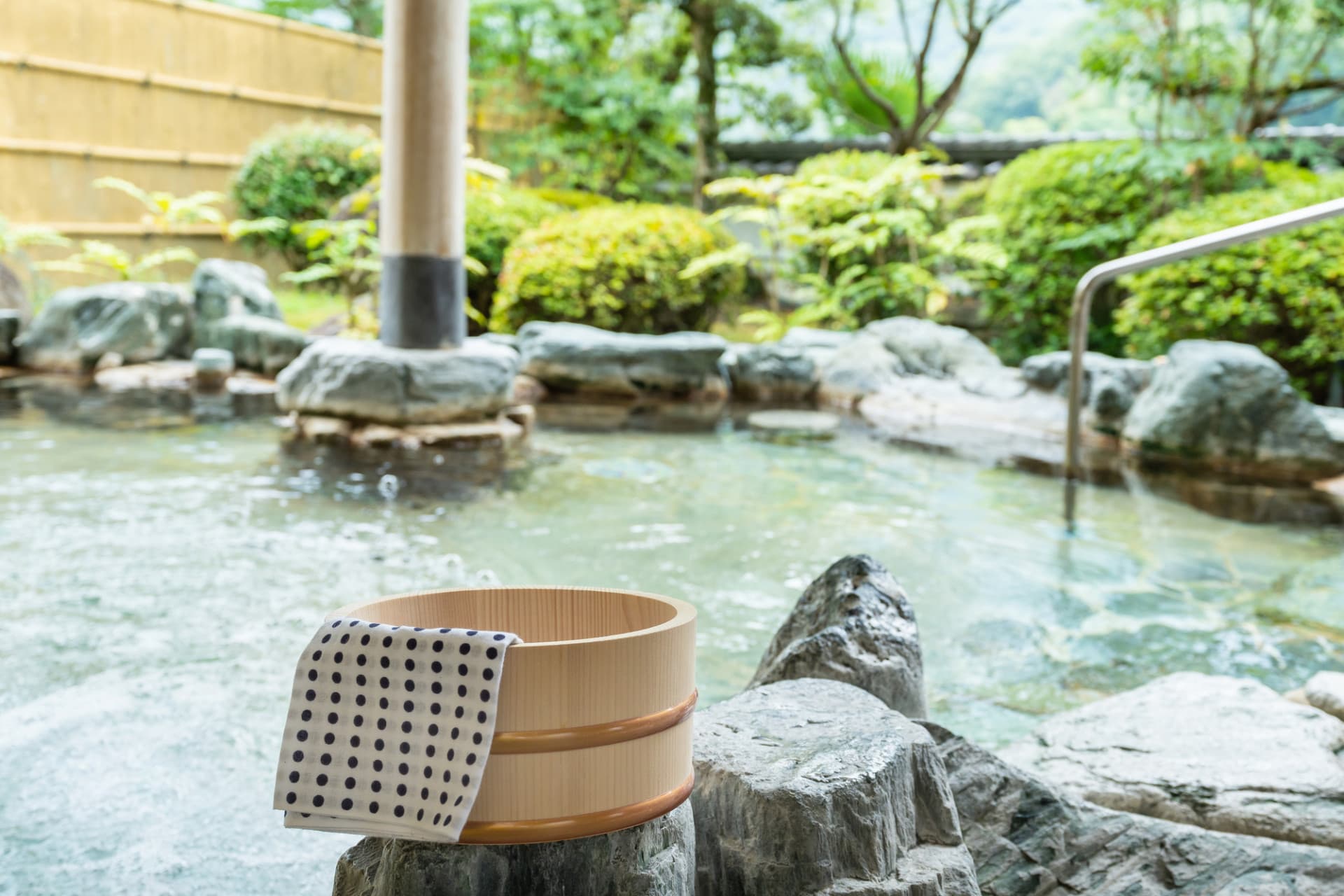
- Towel Etiquette: The small washcloth you bring into the bathing area must never touch the bathtub water. This is to keep the water clean. Place the towel on the edge of the bath or, as the Japanese do, fold it and place it on your head.
- Behavior: Soak quietly. Loud conversation , swimming, splashing, or diving are strictly forbidden.
- Hair: If you have long hair, you must tie it up so it does not touch the water.
- Exiting
- Before returning to the changing room, lightly wipe the moisture from your body with your small washcloth. This is a courtesy to keep the changing room floor dry.
- Don't Rinse: To allow the beneficial minerals from the onsen to remain on your skin, it's recommended not to rinse off with a final shower.
For more details, check out this article.
→The Complete Guide to Japan's Hot Springs for Foreign Travelers, Part 1
Section 1.2: Completely Conquering the "Tattoo Taboo"
Why are tattoos an issue? Historically in Japan, tattoos (irezumi) were associated with the yakuza (organized crime), not with hygiene.
While many traditional facilities still refuse entry to guests with tattoos , the situation is slowly changing due to the increase in inbound tourism.
- "3 Solid Solutions" for Travelers with Tattoos
- Solution 1 (Premium): Private Open-Air Bath (Rotenburo) Book a room at a Ryokan (traditional inn) that comes with its own private onsen (open-air bath). You can enjoy the onsen 24/7 without worrying about anyone else, but this is the most expensive option.
- Solution 2 (Best Balance): Private-Hire Bath (Kashikiri-buro) This is a system where you reserve a private onsen room within the facility (also called Kazoku-buro, or "family bath") by the hour (e.g., 2000-3000 yen for one hour, sometimes free). Merit: It completely avoids the tattoo issue. Furthermore, while public baths are strictly gender-segregated, this is a great advantage that allows couples or families to bathe together.
- Solution 3 (Economy): Cover & Friendly Facilities
- Cover-up Seals: A growing number of facilities allow entry on the condition that you cover your tattoo with a waterproof tattoo cover seal ,. This is a solution also recommended by the Japan Tourism Agency.
- Sento (Public Baths): It's important to differentiate. "Sento" (local public baths, which often use heated tap water instead of natural spring water ) are "99.99% tolerant" of tattoos.
Section 1.3: Choosing Your Experience: Day-Use (Higaeri) vs. Ryokan
- Clarifying Definitions:
- Onsen (温泉): Refers to the "natural hot spring" itself, or the bathing facility that uses it.
- Ryokan (旅館): Refers to a "traditional Japanese inn".
- Onsen Ryokan (温泉旅館): A "Ryokan" that also has "Onsen" facilities.
- Option 1: Day-Use (Higaeri Onsen) This involves visiting a public bath facility without staying overnight, paying only an entrance fee (around 300-2000 yen ). It's inexpensive and easy to fit into a schedule.
- Option 2: Onsen Ryokan This is the ultimate cultural experience. You stay in a tatami room, wear a Yukata (light robe), enjoy a magnificent multi-course Kaiseki dinner made with local ingredients, and soak in the onsen all night long.
Pro Tip: When booking, confirm if the inn is a "Ryokan" or an "Onsen Ryokan" (not all ryokan have onsen ). Also, if you book a room with a private bath, check if the water is "natural hot spring (Tennen Onsen)" or just "hot water".
Chapter 2: The "Big 5" Onsen Destinations Near Tokyo: A Detailed Comparison
We'll dive deep into five major destinations accessible from Tokyo. Understand the "personality" of each to find the perfect trip for you.
1. [Hakone]: The Classic Resort (Perfect for First-Timers)
- Vibe: For inbound travelers, this is undoubtedly the most popular and accessible "classic" onsen destination. It's not just an onsen town; it's a comprehensive mountain resort that combines views of Mt. Fuji , world-class art museums , and a variety of unique transportation methods. The water quality is also incredibly diverse, with 17 different spring types.
- Signature Experiences:
- "Hakone Golden Course" : The classic route that efficiently takes you around all of Hakone's main attractions in a counter-clockwise loop.
- Hakone Open-Air Museum : An outdoor museum featuring a Picasso Pavilion and the "Symphonic Sculpture" (a tower of stained glass).
- Hakone Ropeway : A thrilling ride over the active volcanic vents of Owakudani ("Great Boiling Valley").
- Lake Ashinoko (Lake Ashi) : Cross the lake on a Hakone Pirate Ship. On a clear day, you'll see Mt. Fuji.
- Hakone Shrine : Famous for its "Torii of Peace" gate standing in the water.
- Access & Planning:
- Best Access: From Shinjuku, take the Odakyu Romancecar direct to Hakone-Yumoto Station in about 85-90 minutes.
- Must-Have Item: Hakone Free Pass This is the key to your Hakone trip. It includes one round-trip from Shinjuku and unlimited rides on almost all of the "Golden Course" transportation (Tozan Train, Cable Car, Ropeway, Pirate Ship, and Tozan Buses). It frees you from the stress of buying individual tickets , making it perfect for first-time visitors. Digital versions are also available. *Note: To ride the Romancecar, you must purchase a separate limited express ticket (about 1,200 yen ) in addition to the pass.
2. [Kusatsu]: The Aficionado's Choice (Japan's Best Water Quality)
- Vibe: Known as "the most beloved onsen by the Japanese" , this is a destination where water quality is the star. Located at an altitude of 1200m , the entire town is enveloped in steam, preserving the scenery of a traditional Japanese onsen town. The water, boasting one of Japan's largest natural flow volumes, is characterized by its high temperature (source is ~55°C ) and strong acidity.
- Signature Experiences:
- Yubatake ("Hot Water Field"): The absolute symbol of Kusatsu. 4,000 liters of onsen water gush out every minute , flowing through wooden troughs to cool down naturally. The night illumination is magical.
- Yumomi (Water-Stirring): A traditional method to cool the hot spring water without diluting it. A show is held at the "Netsunoyu" bathhouse , where performers stir the water with large wooden planks to the tune of a folk song.
- Sainokawara Rotenburo (Outdoor Bath): Located within Sainokawara Park , this is a massive outdoor bath. You can bathe in an overwhelmingly open-air setting surrounded by forest.
- Access & Planning:
- Challenge: Kusatsu has no train station.
- Best Access: A direct express bus from Shinjuku or Tokyo Station is the easiest and cheapest option. The journey takes about 4 hours.
- Alternate Route: Take a JR Limited Express train to Naganohara-Kusatsuguchi Station, then a local bus for about 25 minutes (bus fare approx. 710-780 yen ).
3. [Kawaguchiko]: The Mt. Fuji View (Lakeside Scenery)
- Vibe: The purpose is singular: the perfect view of Mt. Fuji. This is a lakeside resort designed for appreciating Japan's most iconic landscape, often while soaking in an onsen.
- Signature Experiences:
- Chureito Pagoda (Arakurayama Sengen Park) : For inbound travelers, this is now the "iconic 'Japan shot,'" perhaps more famous than Mt. Fuji itself. It's the one-of-a-kind spot where you can capture the red five-story pagoda, Mt. Fuji, and (in spring) cherry blossoms all in one photo. Note: It requires climbing nearly 400 steps , and the observation deck can be extremely crowded (sometimes with a 5-minute time limit).
- Onsen with a Mt. Fuji View: The core experience is soaking in an open-air bath or hotel room with an unobstructed view of the mountain.
- SNS Spots: Specific photo-op locations, like the "Mt. Fuji Lawson" convenience store , have become popular.
- Access & Planning:
- Best Access (Cheap/Efficient): Direct express bus from Shinjuku. Takes approx. 1h 45m - 2h , costs ~2,200 yen.
- Best Access (Comfort): Limited Express "Fuji Excursion" from Shinjuku. It's comfortable with no transfers. Takes ~2h , costs ~4,130 yen.
- Must-Have Item: JR TOKYO Wide Pass This pass covers the expensive "Fuji Excursion" and the Fujikyu Line at no extra cost (the regular Japan Rail Pass does not cover the Fujikyu Line ). It also covers Atami (via the Odoriko train) and Nikko (JR lines) , making it the ultimate pass for a 3-day trip exploring multiple onsen areas.
4. [Nikko & Kinugawa]: The Hybrid Trip (World Heritage & Nature)
- Vibe: This is a "hybrid" trip. Nikko focuses on the solemn UNESCO World Heritage shrines and temples and the grand nature of Oku-Nikko (Deep Nikko), including waterfalls and lakes. Kinugawa is a more traditional onsen town with ryokan lining a scenic ravine.
- Signature Experiences:
- Nikko World Heritage: The magnificent "Nikko Toshogu Shrine" and other UNESCO sites.
- Oku-Nikko Nature:
- Kegon Falls: One of Japan's three most famous waterfalls, a spectacular 97-meter drop.
- Lake Chuzenji: The beautiful high-altitude lake that is the source of the falls.
- Kinugawa Onsen:
- Kinugawa River Boat Tour: A scenic boat ride through the ravine navigated by skilled boatmen.
- Access & Planning:
- Best Access: Tobu Railway from Asakusa Station via Limited Express (Spacia or Revaty) takes about 2 hours.
- Alternate Route: A direct JR/Tobu express from Shinjuku also takes about 2 hours.
- Must-Have Item: NIKKO PASS This is an exclusive pass for foreign tourists.
- NIKKO PASS All Area (4 days) : Includes round-trip from Asakusa + unlimited bus/train access to the entire area, including Oku-Nikko (Lake Chuzenji, Kegon Falls). Absolutely necessary if you're going to Oku-Nikko.
- NIKKO PASS World Heritage Area (2 days) : Covers the World Heritage area and Kinugawa Onsen. *Note: For both passes, a separate limited express ticket is required to ride the express trains.
5. [Atami]: The Quickest Getaway (Retro-Modern Seaside & Art)
- Vibe: Boasts the fastest access (as short as 35-45 mins from Tokyo Station by Shinkansen ). This seaside onsen town has successfully rebranded its retro atmosphere with art and food, becoming Japan's #1 most popular domestic onsen destination.
- Signature Experiences:
- MOA Museum of Art: Atami's most important attraction. Located on a hill overlooking the sea , it's known for its stunning architecture and incredible collection of Japanese and East Asian art, including National Treasures.
- Atami Castle: This is not a historical castle; it was built in 1959 for tourism. However, the 360-degree panoramic view from the top is real , and it's a prime spot for viewing the oceanfront fireworks held throughout the year.
- Gourmet & Strolling: Eat-and-walk through the station-front shopping street and enjoy fresh seafood.
- Atami Plum Garden: A famous spot for plum blossoms from winter to early spring (Jan-Mar).
- Access & Planning:
- Best Access (Fastest): Tokaido Shinkansen from Tokyo Station. Takes ~35-50 minutes.
- Best Access (Scenic): Limited Express "Odoriko" from Tokyo or Shinjuku. It runs along the coast and offers beautiful views. Takes ~80 minutes.
- Pass Usage:
- JR Pass (Nationwide): Covers both the Shinkansen and the Odoriko train.
- JR TOKYO Wide Pass: Cannot be used for the Shinkansen, but it covers the Limited Express "Odoriko".
Conclusion: Which Onsen is Right for You?
- If you are...
- ...a "first-timer to Japan" looking for a no-fail classic: Go to Hakone. Buy the Hakone Free Pass and follow the Golden Course.
- ...an "onsen purist" who prioritizes water quality above all: Go to Kusatsu. Take the direct bus , be overwhelmed by the Yubatake , and soak in the Sainokawara Rotenburo.
- ...a "visual hunter" seeking the perfect SNS photo: Go to Kawaguchiko. Check the weather forecast, take the "Fuji Excursion" , and head to the Chureito Pagoda early in the morning.
- ...a "scholar" who wants to deeply explore both history and nature: Go to Nikko & Kinugawa. Get the NIKKO All Area Pass and conquer both the World Heritage sites and Kegon Falls.
- ...an "efficient traveler" who loves art and food and wants minimal travel time: Go to Atami. Arrive in an instant on the Shinkansen , visit the MOA Museum , and enjoy the seafood.
- ...someone who has tattoos and wants to relax without any anxiety: Book a Kashikiri (private bath) at any ryokan, or step through the curtain of a Tokyo sento. That is a place for you.