Part 1 :
Chapter 1: Welcome to the World of Onsen – Beyond the Steam
Chapter 2: Preparation is Key – For the Perfect Onsen Experience
Part 2 : This article
Chapter 3: The Biggest Concern: The Tattoo Question
Chapter 4: The Onsen Ritual: A Step-by-Step Guide
Part 3 :
Chapter 5: The Art of Exiting – Etiquette After the Bath
Chapter 6: Conclusion: You are an "Onsen Master"
Chapter 3: The Biggest Concern: The Tattoo Question
The biggest anxiety for foreign travelers regarding onsen is undoubtedly the tattoo issue. Many facilities display signs stating "Tattoos Prohibited."
Section 3.1: Why are Tattoos a Problem? (Cultural Background)
First, it must be clear that this is not a "Hygiene" issue, but purely a "Historical Association" issue.
- Historical Background: Historically in Japan, tattoos have been perceived in two negative contexts. One was their use as punishment for criminals during the Edo period , and the other was their use by Yakuza (Japanese organized crime) members to show loyalty and resolve.
- Modern Perception: This "Tattoo = Anti-social, Scary" association remains strong, especially among older users and facility operators. Despite the global increase in people getting tattoos for fashion, self-expression, or cultural reasons, this historical stigma still causes friction in Japanese public baths.
Section 3.2: Official Government View and Current Situation
The Japanese government (Japan Tourism Agency) also recognizes this issue as a major barrier to inbound tourism.
- Official View: The Ministry of Health, Labour and Welfare and the Japan Tourism Agency have issued an administrative notice to bathing facilities, stating they should "be mindful that having a tattoo does not pose a sanitary hindrance."
- Recommended Responses: Instead of refusing entry solely because of a tattoo, facilities are asked to respond flexibly, such as :
Section 3.3: Three Realistic Solutions
There are three realistic solutions for travelers with tattoos to enjoy onsen.
- Solution 1: Cover Up This is the most common and accepted method.
- Tattoo Cover Seals: Cover the tattoo with a waterproof, skin-toned sticker to hide it from other bathers. Some facilities (like "Solaniwa Onsen" ) may sell cover seals at the front desk.
- Size Consideration: If the tattoo is small (e.g., fits within a palm), it may not be considered intimidating, and special measures (like covering) may not be required.
- Solution 2: Use a Private Bath (Kashikiriburo) This is the most certain method, as you don't have to worry about others' eyes at all.
- Many onsen ryokan offer "Kashikiriburo" or "Family Baths" that can be reserved by the hour.
- If budget allows, choosing a "room with a private bath" is another option.
- Solution 3: Find "Tattoo-Friendly" Facilities Though limited, the number of onsen and sento that permit tattoos from the outset is increasing. It is wise to search online for keywords like "Tattoo Friendly Onsen" beforehand and list potential places to visit.
The core of the tattoo issue is not logic (hygiene) but emotion (association). The act of "hiding" a tattoo is not a denial of one's identity, but can be seen as a cultural consideration for maintaining Japan's social "Wa" (harmony) and avoiding friction. It is an act that aligns with the fundamental spirit of onsen manners —consideration for the "peace of mind" of others (especially local elderly bathers).
Chapter 4: The Onsen Ritual: A Step-by-Step Guide
Once you are prepared and have the right mindset, it's time to bathe. From here, we will explain the onsen process step-by-step, like a ritual.
Part 4.1: Arrival and Changing Room
- Check the Entrance: "Noren" (Curtains)
- Cloth curtains called "Noren" hang at the bath entrance. Check the color and character to ensure you don't enter the wrong one.
- Color: Generally, blue or navy is for men (Otokoyu), and red or orange is for women (Onnayu).
- Kanji: Men's is "男" (otokoyu) , Women's is "女" (onnayu). Sometimes, Men's is "殿方" (Tono-gata) and Women's is "ご婦人" (Go-fujin).
- Payment
- For day-trip onsen, pay the fee at the front desk (Bandai) or buy a ticket from the vending machine near the entrance. Having coins ready is helpful.
- To the Dressing Room (Datsuijo)
- Take off your shoes or slippers at the dressing room entrance. The dressing room is a "place to purify the body," and beyond this point is considered a clean space.
- Find a locker or a basket. Put valuables in a lockable locker and don't lose the key (often on a wristband).
- Get Undressed
- Take off all your clothes. This is the fundamental rule of Japanese public baths. Wearing a swimsuit is generally prohibited, except at specific spa resorts.
- You might be hesitant at first, but this is the "naked communion" culture, and nobody around you is paying attention to your body.
- Fold your clothes neatly and place them in the basket so they don't overflow.
- What to Bring
- Bring only the "small towel" (and, if needed, the locker key and a spa bag with amenities) into the bathing area. Leave the bath towel in the dressing room.
Part 4.2: The Washing Area (Araiba) Ritual
Do not jump into the bathtub immediately after entering the bathing area. This is the biggest violation of onsen manners. The bathtub (Yubune) is a place to "warm and soak," not to "wash". Japanese bathing begins with purifying the body.
- Step 2a: Kakeyu (Pre-rinse) – Acclimatization
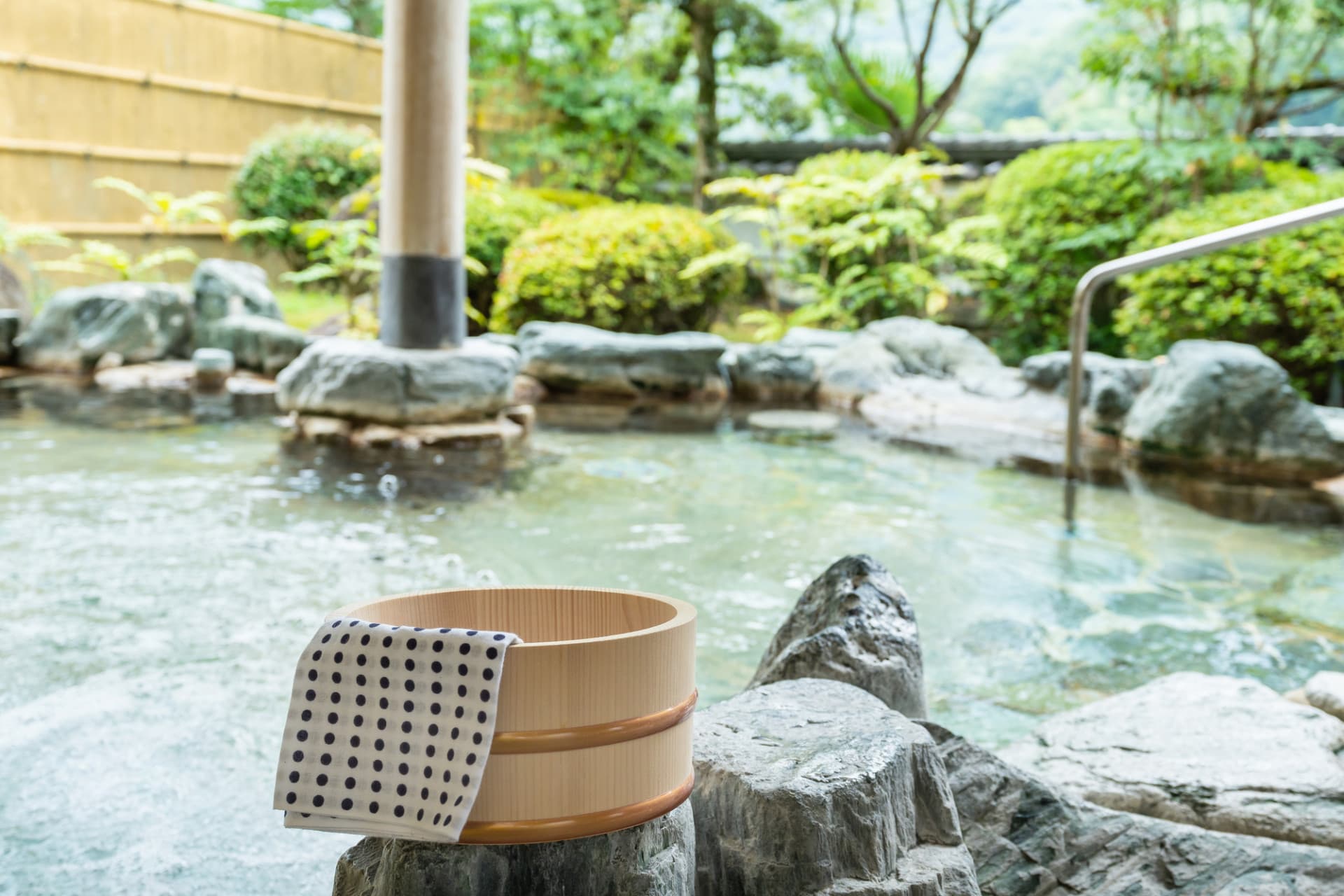
- After entering the bath, first head to the "washing area" or the "kakeyu" spot near the tub, which has buckets.
- Purpose 1 (Health): This is a crucial warm-up. Entering a hot bath suddenly can cause a rapid rise in blood pressure, straining the heart (heat shock). Kakeyu is essential for gradually acclimating your body to the water's temperature.
- Method: Scoop up water with a bucket and pour it over your body, starting farthest from the heart. Begin with your feet, then knees, waist, arms, and shoulders, slowly moving up the body.
- Purpose 2 (Manners): To rinse off surface sweat and dirt, keeping the bathtub clean.
- Step 2b: The Full Wash – Hygiene
- After kakeyu, move to a shower booth in the washing area.
- Wash while sitting: Use the shower while sitting on the provided low stool. Using the shower while standing is considered a major nuisance, as the water and soap will splash onto others. Be especially careful of people behind you.
- Order: It's efficient to wash your head (hair) first, then your body. If you wash your body first, the soap suds and rinsed water from your hair will just make your clean body dirty again.
- When finished:
- Completely rinse off all soap and shampoo from your body with the shower.
- For the next person, briefly rinse the stool and bucket you used with hot water to wash away any suds or dirt.
- Return the tools to their original place (like under the shower hook). The spirit of "returning things in a cleaner state than you found them" is the "consideration" at the heart of Japanese onsen culture.
Part 4.3: Soaking in the Tub (Yubune)
Once your body is completely clean, it's time for the tub.
- Enter quietly: Do not run or jump into the tub, splashing water. Enter slowly and quietly.
- Start with a half-bath (Hanshinyoku): Soaking up to your shoulders immediately can strain your body. Start by soaking up to your solar plexus (below the chest) to acclimate.
- Strict Rule (1): Do not put your towel in the tub
- The "small towel" you brought into the bathing area must not, for any reason, be put in the tub.
- The towel may have germs or soap residue and is thought to contaminate the sacred water.
- Place the towel on the edge of the tub, or, in the style of a Japanese "Tsu" (connoisseur), fold it small and place it on your head.
- Strict Rule (2): Do not let your hair touch the water
- People with long hair must tie it up with a hair tie or (carefully) a towel, ensuring no hair soaks in the tub.
- This is also for hygiene (to prevent loose hairs or styling products from falling in the water) and is an important manner to avoid making others uncomfortable.
- Enjoy quietly: The onsen is a place of quiet relaxation for many. Refrain from loud conversation.
- Try various baths: Enjoy the Rotenburo (open-air bath) , a "Nuruyu" (lukewarm bath) , or a Jacuzzi. Soaking in hot water for too long can make you "nobose" (Dizzy/Overheated). The key to enjoying it safely is to take breaks from the tub at your own pace.
Part1: The Complete Guide to Japan's Hot Springs for Foreign Travelers, Part 1
Part3: The Complete Guide to Japan's Hot Springs for Foreign Travelers, Part 3